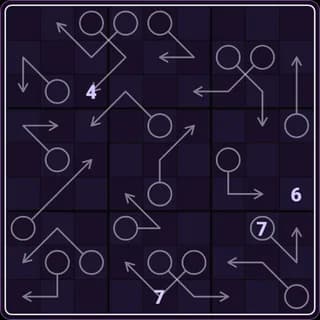
The circle is never counted in its own sum. Because a circle holds a single digit, arrows can only ever total 9 or less, which makes them surprisingly restrictive.
Arrow Sudoku rules in 30 seconds
- 1Every row, column and 3×3 box contains 1–9 exactly once.
- 2The digits on an arrow's shaft add up to the digit in its circle.
- 3Digits may repeat on an arrow if they're in different rows, columns and boxes.
- 4Arrows can bend and point in any direction, including diagonally.
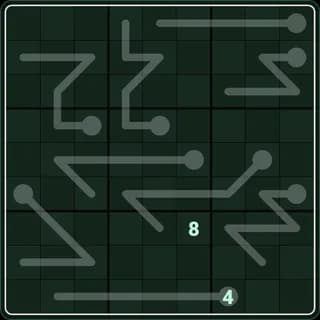
See it on a board
Watch: how to play Arrow Sudoku
Still not sure? Some puzzles click faster when you see them solved. This 17-minute video from Steven Scott shows Arrow Sudoku in action.
Reading an arrow
A circled 7 with two shaft cells could be 1+6, 2+5 or 3+4. A circled 9 with three shaft cells could be 1+3+5, 2+3+4, 1+2+6 and so on. Arrows never overlap, so every sum can be worked out on its own.
Repeats are allowed
An arrow isn't a row, column or box. Two cells on the same arrow may hold the same digit, as long as they don't share a row, column or box. A circled 4 can have a shaft of 2 and 2 if those two cells are far enough apart.
What length tells you
Every shaft cell is at least 1, so a three-cell shaft needs a circle of at least 3, and a four-cell shaft at least 4. Long arrows force big circles, and big circles are the quickest way to place 8s and 9s.
Worked example
- 1A two-cell arrow has a circled 6, and one shaft cell is already 4.
- 26 − 4 = 2, so the other shaft cell is 2.
- 3On a three-cell arrow with a circled 6 and one cell already 4, the other two must be 1 and 1, which only works if those two cells share no row, column or box.
Arrow Sudoku tips and strategies
Start with long arrows
They force large circles and small shaft digits.
Cap the shaft
A shaft cell can never be bigger than the circle minus one for every other shaft cell.
Subtract known cells
Once part of a shaft is known, the rest must make up the difference.
Look for 8s and 9s in circles
Big digits cluster in circles; 1s and 2s cluster on long shafts.
Common mistakes to avoid
- Counting the circle as part of its own sum.
- Assuming arrow digits can't repeat.
- Forgetting that a circle is a single digit, so no arrow can total more than 9.
Play Arrow Sudoku in 10+ Number Puzzles
- Arrows stay drawn under the digits while you work.
- Auto Notes fills candidates from the Sudoku rules and the arrow sums.
- A given digit in a circle fixes that arrow's total outright.
- You have 3 lives. A wrong digit costs one.
- Five difficulty levels, each a ladder of stages from Easy to Genius.
- Go online for free: ranked 1v1 duels, rooms where you race, co-op or play in teams, and tournaments.
- 27 more puzzle types in the same app, and online play never costs coins.

Arrow Sudoku FAQ
Can numbers repeat on an arrow in Arrow Sudoku?
Yes, as long as the repeated digits aren't in the same row, column or box.
Is the circle included in the arrow sum?
No. The circle holds the total; only the shaft cells are added up.
What's the biggest possible arrow total?
9, because the circle holds a single digit.