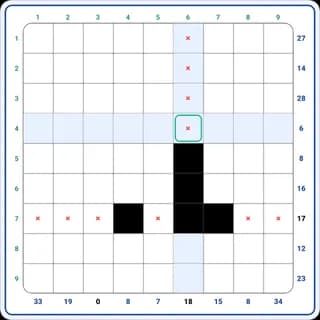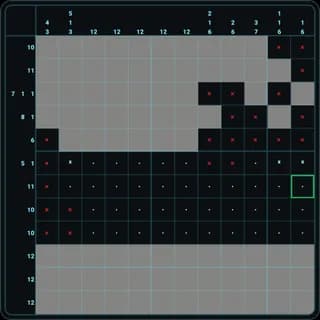
Each clue lists the lengths of the filled blocks in that line, in order. That's all you get, and it's always enough.
Nonograms rules in 30 seconds
- 1Each number is a block of consecutive filled cells.
- 2Blocks appear in the order the clue lists them.
- 3Separate blocks have at least one empty cell between them.
- 4Every row and column must match its clue exactly.
See it on a board
Watch: how to play Nonograms
Still not sure? Some puzzles click faster when you see them solved. This 9-minute video from LokNezMunstr shows Nonograms in action.
Reading a clue
A clue of 3 1 means a block of three filled cells, then later a block of one, with at least one empty cell between them. It doesn't say where the blocks start; working that out is the puzzle.
A clue of 0 (or no numbers) means the whole line is empty.
The overlap trick
When a block is long compared with its line, some cells are filled no matter where it goes. In a 10-cell line with a clue of 7, slide the block as far left as possible, then as far right: the four cells in the middle are covered both times, so they're definitely filled.
For a single block, the number of guaranteed cells is 2 × block − line length (here 2 × 7 − 10 = 4).
Mark the empties
Crossing out cells you know are empty is just as important as filling. Empties split a line into smaller spaces, and a block that doesn't fit in a space can be ruled out of it.
Worked example
- 1A 5-cell row has the clue 5, so the whole row is filled.
- 2Each filled cell now starts a block in its column.
- 3A column with the clue 1 that just received that filled cell is complete, so cross out the rest of that column.
Nonograms tips and strategies
Start with big clues
Large blocks and clues whose total nearly fills the line give instant overlaps.
Use the overlap
Slide each block to its leftmost and rightmost positions; cells covered both times are filled.
Cross out generously
Empties are information. They shrink the space blocks can move in.
Alternate rows and columns
Each line you solve feeds new cells to the lines that cross it.
Common mistakes to avoid
- Forgetting the gap between separate blocks.
- Changing the order of blocks in a clue.
- Filling cells by picture-guessing instead of from the clues.
Play Nonograms in 10+ Number Puzzles
- Choose Fill ■ to paint a cell or X × to mark it empty; long-press in Fill mode places an X quickly.
- Notes place helper dots and small crosses instead of final moves.
- Auto Notes suggests forced fills and forced empties from the clues.
- You have 3 lives, and Add Life restores one up to the maximum.
- Five difficulty levels, each a ladder of stages from Easy to Genius.
- Go online for free: ranked 1v1 duels, rooms where you race, co-op or play in teams, and tournaments.
- 27 more puzzle types in the same app, and online play never costs coins.

Nonograms FAQ
What are Nonograms also called?
Griddlers, Hanjie, Paint by Numbers and Picross® are all names for the same kind of puzzle.
What does 3 1 mean in a Nonogram?
A block of three filled cells followed later by a single filled cell, with at least one empty cell between them.
Do Nonograms always make a picture?
Yes. The filled cells form an image, which is the reward for finishing.