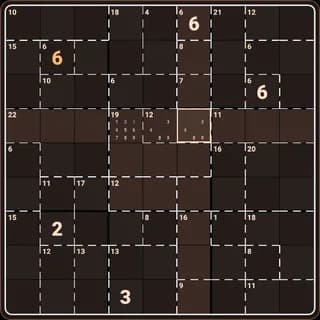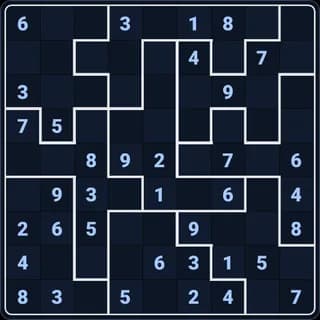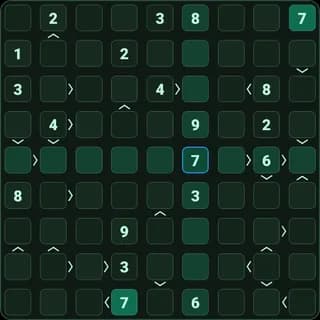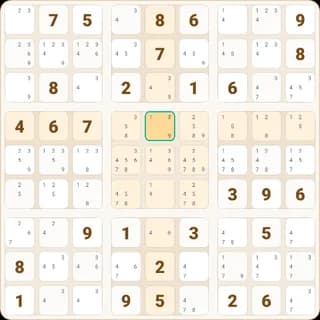
There is no maths involved, despite the numbers. You could play Sudoku with nine letters or nine colours and it would work the same way. What you need is patience and a habit of asking one question over and over: which digits can still go here?
Sudoku rules in 30 seconds
- 1Fill every empty cell with a digit from 1 to 9.
- 2Each row must contain 1–9 exactly once.
- 3Each column must contain 1–9 exactly once.
- 4Each of the nine 3×3 boxes must contain 1–9 exactly once.
- 5The starting numbers are fixed: use them as clues.
See it on a board
Watch: how to play Sudoku
Still not sure? Some puzzles click faster when you see them solved. This short video from Triple S Games shows Sudoku in action.
The Sudoku grid
A Sudoku board has 81 cells arranged in 9 rows and 9 columns. Thicker lines split it into nine 3×3 boxes. Every cell belongs to exactly one row, one column and one box, and each of those three groups has to end up holding 1 to 9 with nothing repeated.
That means every cell has 20 neighbours it has to disagree with: the other eight cells in its row, the other eight in its column, and the four cells in its box that aren't already counted. Placing one digit removes that digit from all 20 of them.
How to start a Sudoku
- Pick a digit, say 5, and find every 5 already on the board.
- Each 5 rules out its row, its column and its box for any other 5.
- Look for a box where only one cell is left that isn't ruled out. That cell must be the 5.
- Repeat for every digit from 1 to 9, then go round again. Each placement opens up new ones.
Using pencil marks
When scanning stops producing answers, start writing candidates: the small digits that could still go in each empty cell. A cell with a single candidate is solved. A digit that appears as a candidate in only one cell of a row, column or box must go there, even if that cell has other candidates too.
Pencil marks turn guesswork into bookkeeping. The best players don't guess at all. They keep narrowing candidates until the board has no choice left.
Worked example: a hidden single
- 1Look at the top-left box. It has three empty cells left, and the box still needs a 7.
- 2Row 1 already has a 7 further along, so the empty cell in row 1 can't be 7.
- 3Column 2 already has a 7 lower down, so the empty cell in column 2 can't be 7 either.
- 4Only one cell in the box can still take the 7. That cell is solved, even though you never worked out what goes in the other two.
Sudoku tips and strategies
Scan by digit
Take one digit at a time and sweep the whole board for places it's forced. It's faster than staring at single cells.
Hunt hidden singles
Ask of every row, column and box: where can the 4 go? If the answer is one cell, you have a placement.
Start where it's crowded
Rows, columns and boxes with six or seven digits already filled have the fewest possibilities left.
Spot pairs
If two cells in a row can only be 3 or 8, those two digits are spoken for. Remove 3 and 8 from the rest of the row.
Never guess
A good Sudoku has exactly one solution and can be reached by logic alone. If you're guessing, there's a deduction you haven't seen yet.
Common mistakes to avoid
- Checking only the row and column and forgetting the box.
- Writing a digit in because it "looks right" before ruling out every other cell.
- Letting pencil marks go stale: when you place a digit, erase it from every candidate list it sees.
- Giving up on a hard board instead of switching to pencil marks.
Play Sudoku in 10+ Number Puzzles
- Tap a cell and its row, column and box light up, so you can see every cell it has to agree with.
- Enter digits from the number pad; tap the same number again to clear it.
- Switch on Notes to pencil in candidates, or use Auto Notes to fill every cell's candidates at once.
- You have 3 lives. A wrong digit costs one, and the board ends when they run out.
- Pausing hides the board and stops the clock, so the timer is always honest.
- Five difficulty levels, each a ladder of stages from Easy to Genius.
- Go online for free: ranked 1v1 duels, rooms where you race, co-op or play in teams, and tournaments.
- 27 more puzzle types in the same app, and online play never costs coins.

Sudoku FAQ
Do you need to be good at maths to play Sudoku?
No. Sudoku uses numbers only as symbols. You never add, subtract or multiply anything. It's pure logic.
Does every Sudoku have only one solution?
A properly made Sudoku has exactly one solution, which is why it can always be solved by reasoning rather than guessing.
What's the minimum number of clues in a Sudoku?
A 9×9 Sudoku with a unique solution needs at least 17 given numbers. Most puzzles start with between 22 and 35.
How long does a Sudoku take?
An easy board might take 5–10 minutes when you're starting out. Harder boards can take 30 minutes or more until you learn the advanced techniques.
What's the best way to get better at Sudoku?
Play a little every day, start on easier levels, and use pencil marks instead of guessing. Once scanning feels automatic, move up a difficulty.