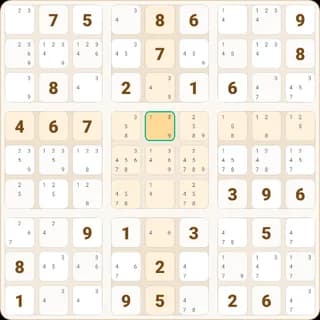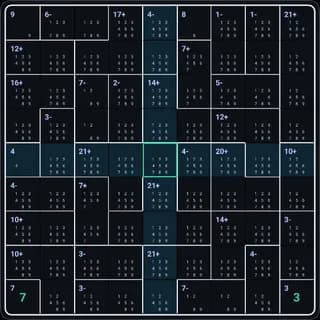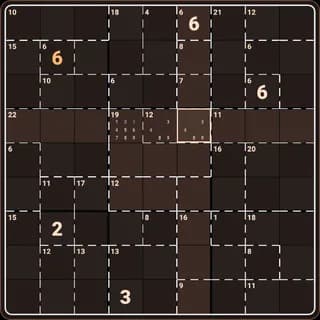
The normal Sudoku rules still apply, so every row, column and 3×3 box holds 1 to 9 once. Harder Killer puzzles often start with no numbers on the board at all. The cage totals are all you get, and they're enough.
Killer Sudoku rules in 30 seconds
- 1Every row, column and 3×3 box contains 1–9 exactly once.
- 2The digits in each cage add up to the cage's total.
- 3A digit can't repeat inside a cage.
- 4A one-cell cage simply tells you its digit.
See it on a board
Watch: how to play Killer Sudoku
Still not sure? Some puzzles click faster when you see them solved. This 10-minute video from puzzlingdotcom shows Killer Sudoku in action.
What a cage tells you
A cage is a group of cells with a target sum, usually printed in its top-left corner. The cage's digits must add up to that target, and no digit may appear twice in the same cage, even when the cage spans several boxes.
Some totals can only be made one way. A two-cell cage of 3 must be 1 and 2. A two-cell cage of 17 must be 8 and 9. A three-cell cage of 6 must be 1, 2 and 3. These "locked" cages are the best place to begin.
The 45 rule
The digits 1 to 9 add up to 45, so every complete row, column and box totals 45. This is the most powerful idea in Killer Sudoku.
If the cages that sit entirely inside a box add up to 38, and one extra cell of the box is left over, that cell must be 45 − 38 = 7. The same trick works for rows, columns, and groups of two or three boxes (90 or 135).
Useful cage combinations
- 2 cells: 3 = 1+2, 4 = 1+3, 16 = 7+9, 17 = 8+9.
- 3 cells: 6 = 1+2+3, 7 = 1+2+4, 23 = 6+8+9, 24 = 7+8+9.
- 4 cells: 10 = 1+2+3+4, 11 = 1+2+3+5, 29 = 5+7+8+9, 30 = 6+7+8+9.
- The smallest and largest totals for any cage size have only one combination.
Worked example
- 1A two-cell cage totals 3, so it must hold 1 and 2 in some order.
- 2One of its cells shares a column with a 1 that's already placed.
- 3That cell can't be 1, so it's the 2, and the other cell is the 1.
- 4Now any cage in the same row that needed a 1 or a 2 has lost that option, and its combinations shrink too.
Killer Sudoku tips and strategies
Start with small and large cages
Extreme totals have the fewest combinations. Pencil in the only digits they can hold.
Use the 45 rule everywhere
Add up the cages inside a row, column or box and compare with 45. The difference points at the cells that stick out.
Subtract as you go
When all but one cell of a cage is known, the last cell is the total minus the rest.
Cross-check combinations
A cage's possible combinations must also fit the row, column and box rules. Throw out any that repeat a placed digit.
Write combinations, not guesses
Use notes to record which digits a cage could contain before you know where each one goes.
Common mistakes to avoid
- Forgetting that digits can't repeat inside a cage, even across box borders.
- Treating a cage total as a hint instead of a hard rule.
- Ignoring the 45 rule, which is how most hard boards are cracked.
- Placing a digit that fits the cage but breaks its row or column.
Play Killer Sudoku in 10+ Number Puzzles
- Cage borders stay visible under the row, column and box highlight, so you always know which total a cell belongs to.
- Use Notes to record the possible combinations for a cage; Auto Notes fills candidates allowed by both Sudoku and cage rules.
- You have 3 lives. A wrong digit costs one.
- Easier stages include some starting digits; the hardest can have none.
- Five difficulty levels, each a ladder of stages from Easy to Genius.
- Go online for free: ranked 1v1 duels, rooms where you race, co-op or play in teams, and tournaments.
- 27 more puzzle types in the same app, and online play never costs coins.

Killer Sudoku FAQ
Is Killer Sudoku harder than normal Sudoku?
Usually, yes, because you juggle sums as well as placements. But the extra clues also give you more ways in, so many players find mid-level Killer boards very satisfying.
Can digits repeat in a Killer Sudoku cage?
No. Each cage holds different digits, in addition to the normal row, column and box rules.
What is the 45 rule in Killer Sudoku?
Every row, column and box adds up to 45. Comparing that with the cage totals inside it often reveals single cells directly.
Why do some Killer Sudokus have no numbers at the start?
The cage totals carry enough information on their own. Starting from an empty grid is common in harder puzzles.