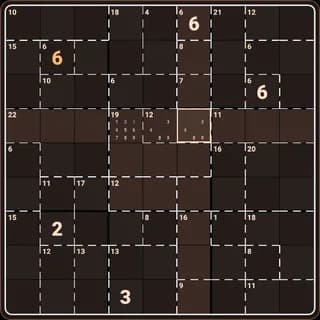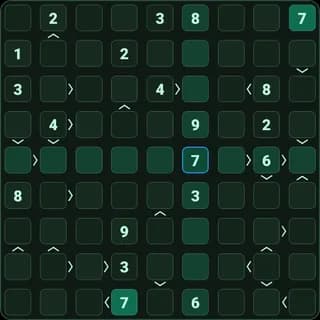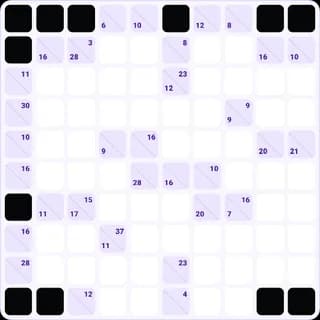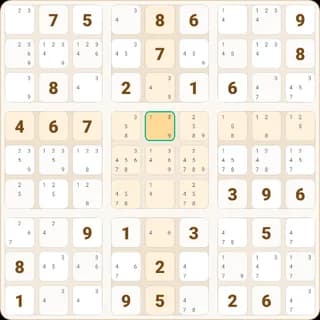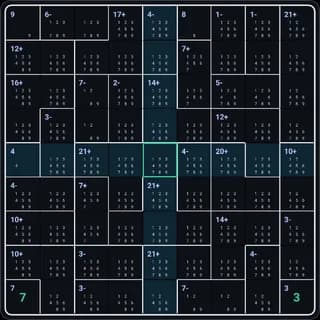
Each cage shows a target and an operation: add, subtract, multiply or divide. The numbers in the cage must combine to make that target. There are no 3×3 boxes, just rows, columns and cages.
Calcudoku rules in 30 seconds
- 1An N×N grid uses the numbers 1 to N (a 6×6 uses 1–6).
- 2No number repeats in any row or column.
- 3The numbers in each cage combine with its operation to make its target.
- 4A single-cell cage just tells you its number.
See it on a board
Watch: how to play Calcudoku
Still not sure? Some puzzles click faster when you see them solved. This 2-minute video from KenKenPuzzle shows Calcudoku in action.
How each operation works
- Addition (+): add every number in the cage. A three-cell 9+ could be 2, 3 and 4.
- Multiplication (×): multiply every number in the cage. A two-cell 12× could be 3 and 4.
- Subtraction (−): two cells whose difference is the target, in either order.
- Division (÷): two cells where the larger divided by the smaller is the target.
- No operation: a one-cell cage. Write its number straight in.
Can numbers repeat in a cage?
Yes, if the cage is bent so that the repeated numbers sit in different rows and different columns. An L-shaped 3-cell 5+ cage could be 2, 1, 2, as long as the two 2s don't share a row or column. The row and column rule always wins.
Worked example
- 1A two-cell cage shows 2÷ in a 4×4 grid, so its pair is 1–2 or 2–4.
- 2The same row already has a 1, so the pair must be 2 and 4.
- 3A column crossing the cage already has a 4, which decides which cell gets the 2.
Calcudoku tips and strategies
Fill single-cell cages first
They're free placements, and each one removes a number from its row and column.
List the pairs
Subtraction and division cages have only a handful of possible pairs. Write them down.
Use big products
A large × target often needs the biggest numbers, and some products can only be made one way.
Revisit near-finished cages
When all but one cell is known, the last cell is just arithmetic.
Common mistakes to avoid
- Taking the smaller number from the larger in the wrong order. Subtraction and division always use larger then smaller.
- Forgetting that a combination which hits the target can still break a row or column.
- Using numbers bigger than the grid size.
Play Calcudoku in 10+ Number Puzzles
- Boards grow with difficulty: 4×4 on Easy, 5×5, 6×6, 8×8 and 9×9 on Genius.
- Tap a cell to see its row and column; cage borders show which target applies.
- Notes let you compare cage combinations without guessing.
- You have 3 lives. A wrong number costs one.
- Five difficulty levels, each a ladder of stages from Easy to Genius.
- Go online for free: ranked 1v1 duels, rooms where you race, co-op or play in teams, and tournaments.
- 27 more puzzle types in the same app, and online play never costs coins.

Calcudoku FAQ
Is Calcudoku the same as KenKen?
They follow the same rules. KenKen® is a trademarked name for this style of puzzle; Calcudoku and Mathdoku are the generic names.
Does Calcudoku have 3×3 boxes like Sudoku?
No. Only rows, columns and cages matter.
What size is a Calcudoku grid?
Anything from 3×3 upward. In the app, boards grow from 4×4 on Easy to 9×9 on Genius.
Is Calcudoku good for practising maths?
Yes. It's gentle arithmetic wrapped in logic, which makes it a popular brain-training puzzle for all ages.