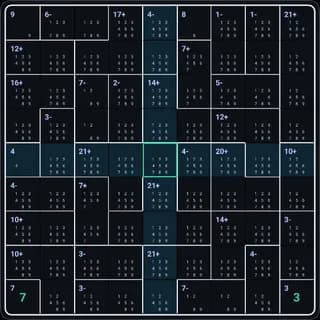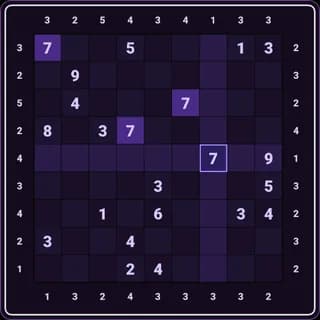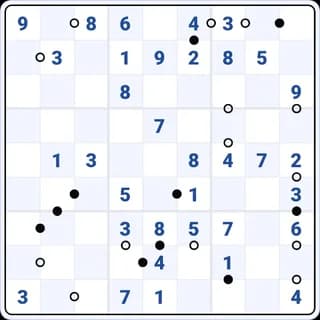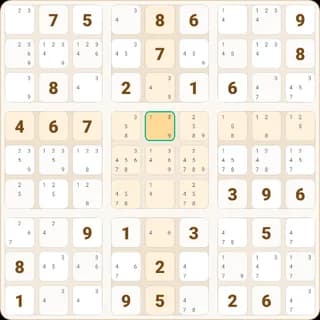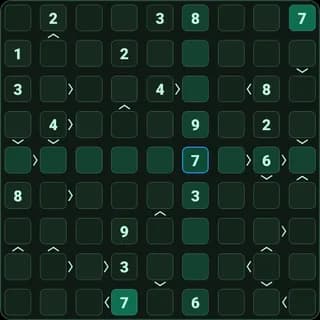
The signs are the whole puzzle. A few given numbers anchor the grid, and chains of signs do the rest.
Futoshiki rules in 30 seconds
- 1An N×N grid uses the numbers 1 to N.
- 2Each row and column contains every number exactly once.
- 3Every < or > sign between two cells must be true.
- 4Signs only compare the two cells they sit between.
See it on a board
Watch: how to play Futoshiki
Still not sure? Some puzzles click faster when you see them solved. This 8-minute video from Steven Scott shows Futoshiki in action.
Reading the signs
The open side of a sign faces the bigger number, just like in maths. In A > B, A is larger. Vertical signs work the same way: the point of the sign is at the smaller cell.
A sign says nothing about how much bigger, only that it's bigger. 5 > 1 and 5 > 4 both satisfy it.
Inequality chains
Signs often link into chains. If A > B > C, then A can't be 1 or 2, and C can't be the two largest numbers. On a 5×5, a chain of four signs in a row fixes every cell in it: 5 > 4 > 3 > 2 > 1.
How to start a Futoshiki
- Any cell on the big side of a sign can't be 1. Any cell on the small side can't be the largest number.
- Pencil in each cell's range from the chains it belongs to before placing anything.
- Look for rows and columns where only one cell can take the largest (or smallest) number.
- When a given number sits next to a sign, it immediately caps or floors its neighbour.
Worked example
- 1On a 5×5 grid, a cell is smaller than both of its neighbours.
- 2It can't be 5, and if the row already has its 1 elsewhere, it can't be 1 either.
- 3Combined with the column's placed numbers, that often leaves a single option.
Futoshiki tips and strategies
Follow chains
The longer the chain, the tighter each cell's range.
Find the extremes
A cell greater than several neighbours is likely a high number, and it can never be 1.
Place the 1s and Ns
The smallest can't sit on the big side of any sign; the largest can't sit on the small side.
Combine with row and column
Remove numbers already used in the line, then check the signs.
Common mistakes to avoid
- Reading a sign backwards. The open side always faces the bigger number.
- Assuming a sign affects cells beyond the two it touches.
Play Futoshiki in 10+ Number Puzzles
- Grids grow with difficulty: 5×5 on Easy up to 9×9 on Genius.
- Tap a cell to highlight its row and column; signs stay visible.
- Notes and Auto Notes help track candidates.
- You have 3 lives. A wrong number costs one.
- Five difficulty levels, each a ladder of stages from Easy to Genius.
- Go online for free: ranked 1v1 duels, rooms where you race, co-op or play in teams, and tournaments.
- 27 more puzzle types in the same app, and online play never costs coins.

Futoshiki FAQ
What does Futoshiki mean?
It's Japanese for "inequality" (literally "not equal").
Does Futoshiki have boxes like Sudoku?
No. Only rows and columns must avoid repeats.
What size is a Futoshiki grid?
Usually 4×4 to 9×9. In the app, Easy starts at 5×5 and Genius is 9×9.