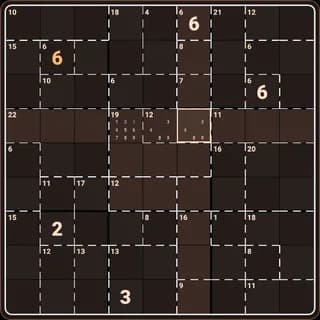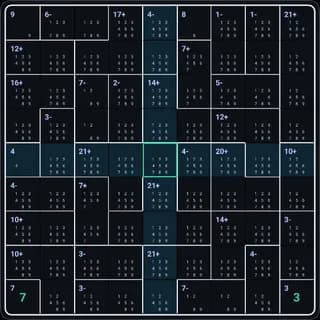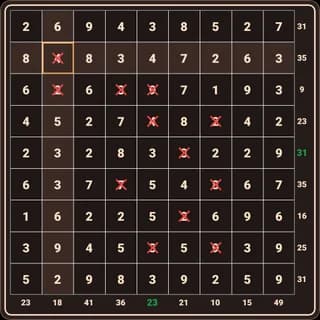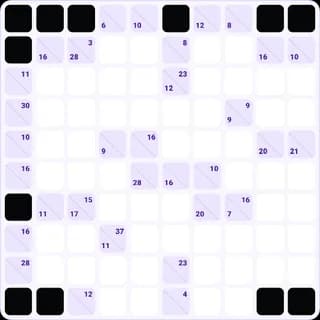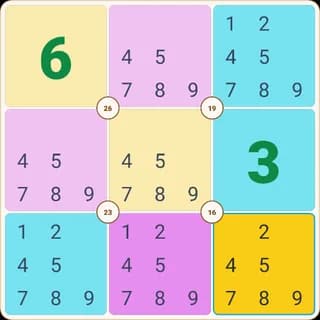
Four circles sit where the grid lines cross, and each one gives the total of the four cells around it. The cells are also split into coloured regions, each with its own total. Small board, lots of overlapping logic.
Circle-Sum Sudoku rules in 30 seconds
- 1Fill the 3×3 grid with 1–9, each digit exactly once.
- 2Each circle equals the sum of the four cells touching it.
- 3Each coloured region equals its own target total.
- 4The whole board always adds up to 45.
See it on a board
Watch: how to play Circle-Sum Sudoku
Still not sure? Some puzzles click faster when you see them solved. This 5-minute video from Andrew Jeffrey shows Circle-Sum Sudoku in action.
Which cells each circle uses
Label the cells A to I, left to right, top to bottom. The top-left circle is A+B+D+E, the top-right is B+C+E+F, the bottom-left is D+E+G+H and the bottom-right is E+F+H+I.
Corners belong to one circle, edge cells to two, and the centre cell E to all four. That makes the centre the most important cell on the board.
Coloured regions
The cells are also grouped by colour. Add every cell of one colour and it must equal that region's target. Regions don't have to be rows or columns, so follow the colours on the board.
One equation that links every circle
Add all four circle totals together. Each corner is counted once, each edge cell twice and the centre four times. Since the whole board is 45, that sum always equals 45 + (the four edge cells) + 3 × (the centre).
That single line of arithmetic tells you a lot. Very large circle totals mean a big centre or big edge cells; small totals push the high digits into the corners.
Worked example
- 1A circle totals 22, and three of its cells are already 4, 7 and 8.
- 222 − 4 − 7 − 8 = 3, so its last cell is 3.
- 3Two neighbouring circles share their two middle cells, so the difference between their totals equals the difference between their outer cells.
Circle-Sum Sudoku tips and strategies
Solve the centre early
The centre is in every circle. Once it's known, each circle becomes a three-cell problem.
Compare neighbouring circles
Subtracting one circle from its neighbour cancels the shared cells.
Use the 45 total
If two regions are known, the third region's cells must make up the rest of 45.
Track used digits
Each digit appears once on the whole board, so cross it off everywhere once placed.
Common mistakes to avoid
- Using a digit twice. Every digit appears exactly once on the board.
- Solving circles and regions separately instead of letting them check each other.
- Deciding the order of a pair before a crossing clue confirms it.
Play Circle-Sum Sudoku in 10+ Number Puzzles
- Tap a cell and use the circles and its region's total to decide what fits.
- Auto Notes fills candidates from the unused digits and the current sums.
- You have 3 lives. A wrong digit costs one, and Add Life can restore one when available.
- Five difficulty levels, each a ladder of stages from Easy to Genius.
- Go online for free: ranked 1v1 duels, rooms where you race, co-op or play in teams, and tournaments.
- 27 more puzzle types in the same app, and online play never costs coins.

Circle-Sum Sudoku FAQ
How big is a Circle-Sum Sudoku?
3×3: nine cells filled with the digits 1 to 9, each used once.
Why is the centre cell so important?
It's part of all four circle sums, so its value changes every circle at once.
What does the whole grid add up to?
Always 45, the sum of 1 through 9.