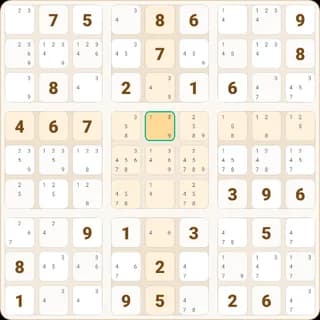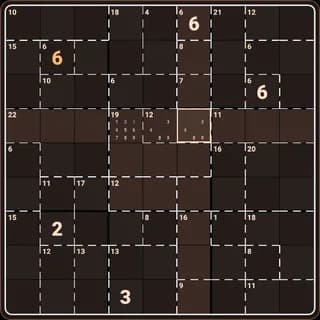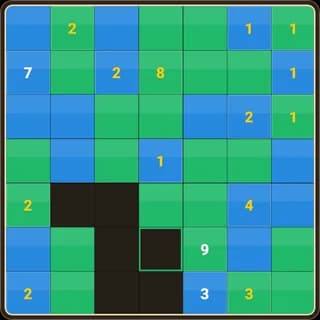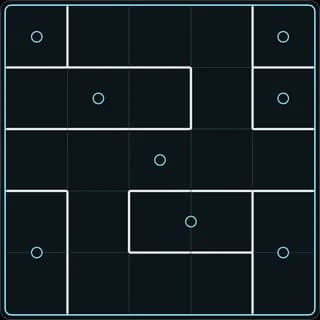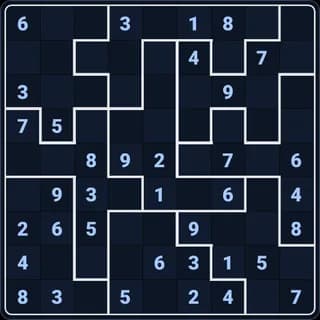
Rows and columns work exactly as they always do. But regions can be any shape (an L, a zigzag, a staircase), so they reach across rows and columns in ways boxes never do.
Jigsaw Sudoku rules in 30 seconds
- 1Every row contains 1–9 exactly once.
- 2Every column contains 1–9 exactly once.
- 3Every heavy-outlined region contains 1–9 exactly once.
- 4There is no 3×3 box rule.
See it on a board
Watch: how to play Jigsaw Sudoku
Still not sure? Some puzzles click faster when you see them solved. This 23-minute video from Steven Scott shows Jigsaw Sudoku in action.
How regions work
- There are always nine regions of nine cells each.
- Each region is one connected piece.
- Regions can be any shape at all.
- Three cells that happen to sit in a neat square may belong to different regions and can legally repeat a digit.
Why regions are powerful
A 3×3 box spans three rows and three columns. An irregular region can span up to nine of each. A long, thin region that covers most of a column shares nearly all its digits with that column, which forces the few cells outside the overlap almost immediately.
How to start a Jigsaw Sudoku
- Tap around the board once just to learn the region shapes before placing anything.
- Scan by digit exactly as in normal Sudoku, but eliminate by region instead of by box.
- Look for regions that are nearly full of givens: they often have a single forced cell.
- Use the "law of leftovers": when a few regions almost exactly cover the same number of rows, the region cells sticking out of those rows hold the same digits as the row cells the regions miss.
Worked example: one cell in a row
- 1A region reaches into row 4 with a single cell.
- 2The region still needs a 6, and every other region cell has a 6 in its row or column already.
- 3So the single cell in row 4 is the region's only place for 6.
Jigsaw Sudoku tips and strategies
Trace the heavy lines
Nearly every Jigsaw mistake is a cell put in the wrong region. Follow the outline before ruling anything out.
Compare overlapping houses
When a region covers most of a row, the row and the region need almost the same digits. The leftovers are forced.
Watch single-cell reach
Where a region pokes into a row or column by one cell, that cell usually has very few options.
Count both ways
Ask what a region still needs, then ask which of its cells can still take each digit.
Common mistakes to avoid
- Ruling out a digit because it appears in "that 3×3 area". There are no boxes.
- Misreading a region's outline around a tight corner.
Play Jigsaw Sudoku in 10+ Number Puzzles
- Tap any cell and its whole region lights up, the fastest way to read a twisted shape.
- Auto Notes uses rows, columns and regions to fill candidates.
- Harder levels have fewer givens and more twisted regions.
- You have 3 lives. A wrong digit costs one.
- Five difficulty levels, each a ladder of stages from Easy to Genius.
- Go online for free: ranked 1v1 duels, rooms where you race, co-op or play in teams, and tournaments.
- 27 more puzzle types in the same app, and online play never costs coins.

Jigsaw Sudoku FAQ
What is the difference between Jigsaw Sudoku and Sudoku?
Rows and columns are the same, but the 3×3 boxes are replaced with nine irregular regions of nine cells.
Is Jigsaw Sudoku harder than regular Sudoku?
It feels different more than harder. The odd shapes create new deductions, and once you trust the outlines it flows quickly.
Do Jigsaw Sudoku regions always have nine cells?
Yes. Nine regions of nine cells, each holding 1 to 9 once.