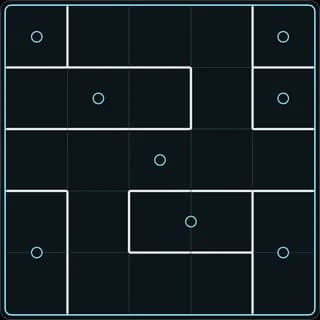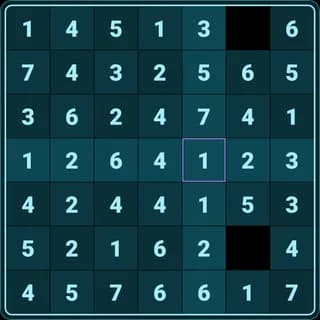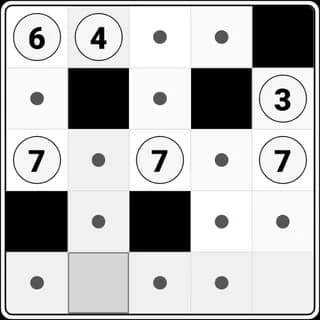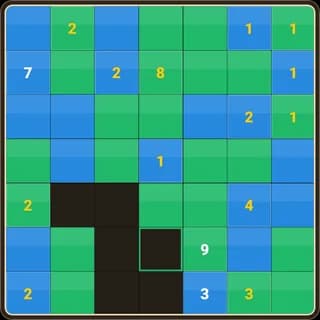
Each field must contain exactly one numbered clue, and that number must equal how many cells the field has. If you enjoy region puzzles like Nurikabe or Fillomino, Fields will feel instantly familiar, with a colourful twist.
Fields rules in 30 seconds
- 1Paint every cell green or blue.
- 2Same-coloured cells that touch side by side form one field.
- 3Every field contains exactly one number.
- 4That number equals the field's size in cells.
See it on a board
Watch: how to play Fields
Still not sure? Some puzzles click faster when you see them solved. This 4-minute video from Inkwell Games shows Fields in action.
One clue per field
A field with no number isn't allowed, and a field with two numbers isn't either. So two same-coloured clues must always be kept apart by the other colour, and every painted patch has to reach a clue.
Numbered cells come with their colour already set. Use that colour and the number to work out how far the field can spread.
The number is exact
A clue of 5 needs exactly five connected cells: four is too small, six is too big. Once a field reaches its size, every neighbouring cell outside it must be the other colour.
Diagonal touching doesn't connect anything. Two green cells meeting only at a corner are in different fields.
How to start a Fields puzzle
- Every clue of 1 is already a complete field, so all its neighbours are the other colour.
- Find cells sitting between two same-coloured clues. Joining them would merge two numbers, so they're often forced to the opposite colour.
- Look for cells that no clue could reach without getting too big. Those cells must join a field of the other colour.
- Grow small clues first: a 2 or a 3 in a tight corner usually has only one possible shape.
Worked example
- 1A green 3 already connects to two other green cells, so the field is full.
- 2Every cell touching that field from outside must be blue.
- 3Those new blue cells may now join a blue field, which is how one finished field starts solving its neighbours.
Fields tips and strategies
Close full fields
Once a field reaches its number, paint its border cells the other colour.
Separate same-colour clues
Two green numbers can never end up in one field. Cells between them are often forced blue.
Count reach
How far can a clue spread before it would touch another same-coloured clue?
Test both colours
If green makes a field too big or merges two clues, the cell is blue.
Common mistakes to avoid
- Letting two same-coloured clues join into one field.
- Treating diagonal contact as a connection.
- Leaving a patch of colour with no number in it.
Play Fields in 10+ Number Puzzles
- Tap to cycle a cell green → blue → empty; long-press to clear it.
- Nothing is judged as you go. Colour freely and change your mind.
- Check Game highlights every field that breaks a rule. A Check that finds a problem costs a life; a clean Check is free.
- Notes pencil in a candidate colour without committing.
- Five difficulty levels, each a ladder of stages from Easy to Genius.
- Go online for free: ranked 1v1 duels, rooms where you race, co-op or play in teams, and tournaments.
- 27 more puzzle types in the same app, and online play never costs coins.

Fields FAQ
Do I need equal amounts of green and blue in Fields?
No. The colours don't need to balance. Only the field sizes matter.
Can a field have two numbers?
No. Every finished field holds exactly one number.
Do diagonal cells connect in Fields?
No. Cells only join a field by sharing an edge.