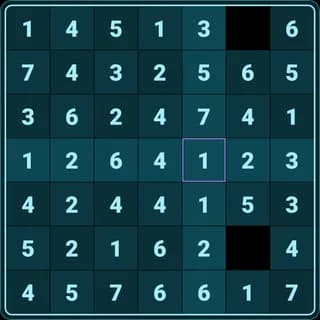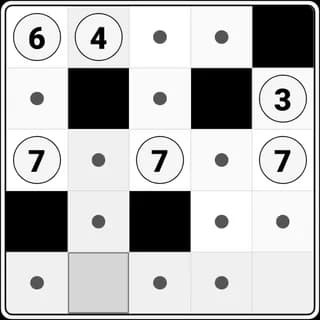
Black cells block sight lines like walls. They can't touch each other side by side, and the white cells must stay connected as a single area.
Kurodoko rules in 30 seconds
- 1Each number sees exactly that many white cells in four straight lines, including itself.
- 2Black cells block the view in that direction.
- 3Numbered cells are always white.
- 4Black cells never touch side by side.
- 5All white cells stay connected.
See it on a board
Watch: how to play Kurodoko
Still not sure? Some puzzles click faster when you see them solved. This 8-minute video from Pathologic shows Kurodoko in action.
Counting what a number sees
From a numbered cell, look in each of the four directions and count white cells until you hit a black cell or the edge of the board. Add all four directions together, then add 1 for the numbered cell itself. Diagonals never count.
So a 1 can see nothing but itself: every neighbour must be black or the board edge. A 5 in open space might see one cell each way.
Too few is final, too many is temporary
If you block a clue so it can see fewer cells than it needs, that can never be fixed. If it currently sees too many, that's fine while cells are undecided, because a later black cell can still shorten the view.
How to start a Kurodoko
- Mark every numbered cell white. Clues are never black.
- Take the smallest clues first. A 2 sees exactly one other cell, so three of its directions must be blocked quickly.
- Take the largest clues next. Count the most cells they could possibly see; if that's barely enough, every one of those cells is white.
- After placing a black cell, whiten its four neighbours and check that no white area has been cut off.
Worked example
- 1A 4 sits in a corner, so it can only look in two directions.
- 2It sees itself, so it needs 3 more white cells between those two lines.
- 3If one direction is already blocked after one cell, the other direction must reach exactly two cells and then be stopped by a black cell.
Kurodoko tips and strategies
Start small
Small clues need blockers close by, and blockers force their neighbours white.
Whiten around blacks
Every neighbour of a black cell must be white.
Guard the bridges
A cell that's the only link between two white areas must stay white.
Check both states
If making a cell black breaks a rule, it's white, and vice versa.
Common mistakes to avoid
- Forgetting that a number counts itself.
- Blocking a clue below its number too early.
- Cutting the white area in two with a black cell.
Play Kurodoko in 10+ Number Puzzles
- Select a cell and mark it black or white; clear a mark to rethink it.
- Rule-breaking moves can be spotted during play, and Check confirms a finished board.
- Boards grow from 5×5 on Easy through 7×7, 9×9 and 10×10 to 12×12 on Genius.
- Five difficulty levels, each a ladder of stages from Easy to Genius.
- Go online for free: ranked 1v1 duels, rooms where you race, co-op or play in teams, and tournaments.
- 27 more puzzle types in the same app, and online play never costs coins.
Kurodoko FAQ
Does the number count its own cell in Kurodoko?
Yes. A clue of 1 sees only itself, so every direction must be blocked straight away.
Can black cells touch diagonally in Kurodoko?
Yes. Only side-by-side and up-and-down contact is forbidden.
What does Kurodoko mean?
It's Japanese, roughly "where is black?", which is exactly the question you ask on every cell.