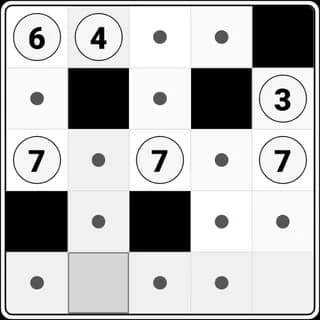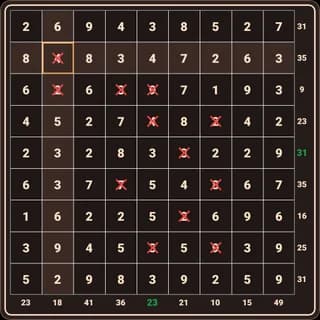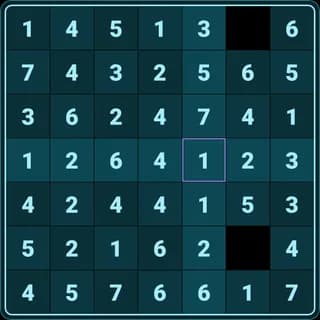
Two more rules keep it honest: shaded cells can never touch side by side, and all the white cells must stay connected as one area.
Hitori rules in 30 seconds
- 1Shade cells so no number repeats in any row or column among white cells.
- 2Shaded cells may not touch horizontally or vertically.
- 3All white cells must form one connected area.
- 4You never write numbers; you only decide black or white.
See it on a board
Watch: how to play Hitori
Still not sure? Some puzzles click faster when you see them solved. This 15-minute video from Steven Scott shows Hitori in action.
The three rules together
Each rule alone is easy. The puzzle comes from satisfying all three at once. When a number repeats, one of the copies has to go. But shading it might put two black cells side by side, or cut off a pocket of white cells. The right choice is the one that breaks nothing.
Classic Hitori patterns
- Sandwich: in 3 5 3, one of the 3s must be shaded, and both of them touch the 5. So the 5 stays white.
- Pair and a single: in 4 4 7 4, if the lone 4 stayed white, both 4s of the pair would need shading, and they touch. So the lone 4 is shaded.
- Neighbours of black: every cell touching a shaded cell must be white.
- Corner squeeze: shading a cell that would isolate a corner white cell is always wrong.
Worked example
- 1A row reads 2 1 2. One of the two 2s must be shaded.
- 2The column through the first 2 has another 2, but the column through the second doesn't.
- 3Shading the first 2 fixes the row and its column at once, so shade it and mark its neighbours white.
Hitori tips and strategies
Mark whites early
Every cell next to a shaded cell is white. Dots make that visible.
Protect connectivity
Before shading, check you aren't sealing off a white area.
Start at edges and corners
Corners have only two neighbours, so connectivity problems show up there first.
Look for triples
Three of the same number in a row often forces a whole pattern at once.
Common mistakes to avoid
- Shading two cells that touch side by side.
- Leaving a white cell cut off from the rest.
- Shading a number that isn't actually repeated anywhere.
Play Hitori in 10+ Number Puzzles
- Tap to shade a cell; long-press to drop a dot that means "this stays white". Notes mode swaps the two.
- Auto Notes adds dot hints for duplicated values.
- Press Check Game when you want feedback. It checks the rules only, so an unfinished board that breaks nothing is always free to check; a broken rule costs a life.
- Boards grow from 5×5 on Easy to 9×9 on Genius.
- Five difficulty levels, each a ladder of stages from Easy to Genius.
- Go online for free: ranked 1v1 duels, rooms where you race, co-op or play in teams, and tournaments.
- 27 more puzzle types in the same app, and online play never costs coins.

Hitori FAQ
What does Hitori mean?
It's Japanese for "alone", fitting for a puzzle where every number must end up alone in its row and column.
Can black cells touch in Hitori?
Diagonally, yes. Side by side or above and below, never.
Do all white cells have to connect?
Yes. You must be able to walk from any white cell to any other through white cells, moving up, down, left or right.