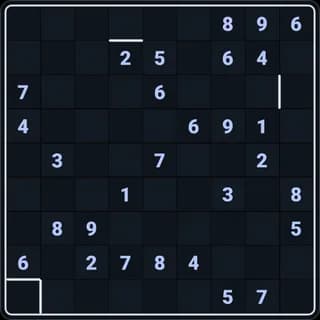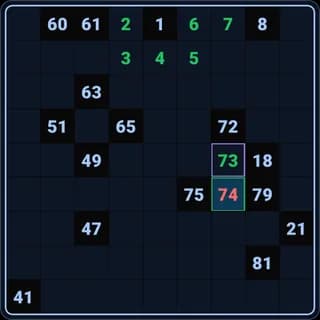
Some numbers are given as anchors. Your job is to thread the missing numbers between them without ever stepping diagonally.
Number-Path rules in 30 seconds
- 1Every cell gets exactly one number.
- 2Consecutive numbers must touch up, down, left or right.
- 3Diagonal steps never count.
- 4The finished grid is one path from 1 to the highest number.
See it on a board
Watch: how to play Number-Path
Still not sure? Some puzzles click faster when you see them solved. This short video from Leony Tham shows Number-Path in action.
Reading the gaps
The distance between two given numbers tells you how many steps the path takes between them. If 12 and 14 are given, 13 must sit in a cell touching both. If 20 and 26 are given, the path needs exactly six steps to get from one to the other, which rules out any cells that are too far away.
The checkerboard trick
Imagine the grid coloured like a chessboard. Every step up, down, left or right lands on the other colour, so the path alternates colours all the way along. That means all the odd numbers sit on one colour and all the even numbers on the other.
Use it to rule cells out instantly: if 7 is on a light square, then 8 can never be on a light square, and neither can any other even number.
How to start a Number-Path
- Find the givens that are closest together in value and fill the gaps between them first.
- Count steps: two givens n apart need exactly n − 1 cells between them, reachable in exactly n moves.
- Watch corners and edges. A corner cell has only two neighbours, so the path must enter and leave through them.
- Avoid dead ends: every cell except the first and last needs two path neighbours, so never box an empty cell in.
Worked example
- 112 and 14 sit diagonally from each other.
- 2Two cells touch both of them: one above-right, one below-left.
- 3If one of those is already taken, 13 goes in the other.
Number-Path tips and strategies
Fill the tight gaps first
Pairs like 12 and 14 have only one or two possible middles.
Work from the ends
The cells around 1 and the highest number are often the most constrained.
Count steps
If two givens are 5 apart, the path between them uses exactly 4 cells. Too far, and a route is impossible.
Don't wall yourself in
Leave room for later numbers. A dead-end corner usually means a wrong turn.
Common mistakes to avoid
- Connecting numbers diagonally.
- Leaving an isolated empty cell that no path can reach.
Play Number-Path in 10+ Number Puzzles
- Tap a cell and enter a number; givens can't be changed.
- Try a wrong number and the app briefly shows it before you lose a life.
- You have 3 lives, and Notes help when more than one number seems possible.
- Five difficulty levels, each a ladder of stages from Easy to Genius.
- Go online for free: ranked 1v1 duels, rooms where you race, co-op or play in teams, and tournaments.
- 27 more puzzle types in the same app, and online play never costs coins.

Number-Path FAQ
Can the path move diagonally?
No. Each number must touch the next one directly above, below, left or right.
Is Number-Path the same as Numbrix?
It follows the same idea as the Numbrix® puzzles created by Marilyn vos Savant: a path of consecutive numbers with no diagonal moves.
How is it different from Hidato?
Hidato allows diagonal steps. Number-Path doesn't.