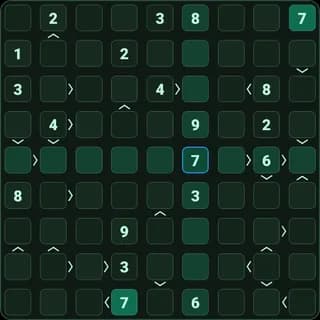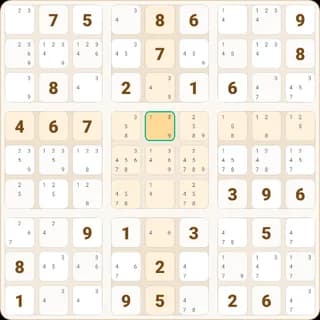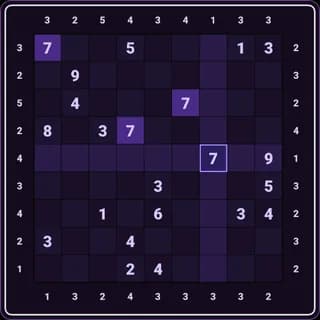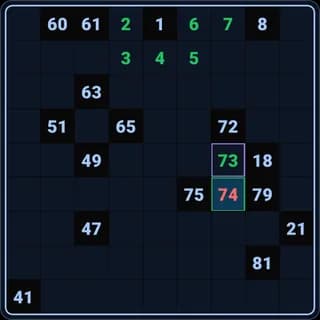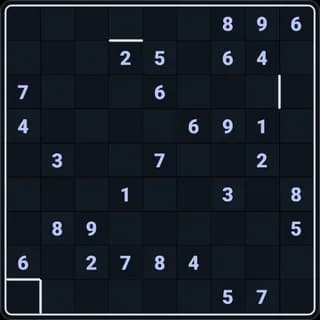
Every cell sits in one horizontal segment and one vertical segment, and its number must fit both. Unlike Sudoku, a number can repeat in a full row as long as the copies are in different segments.
One Up rules in 30 seconds
- 1Walls and the board edge split rows and columns into segments.
- 2A segment of N cells contains every number from 1 to N exactly once.
- 3Each cell must fit both its horizontal and its vertical segment.
- 4Numbers may repeat in a row or column if a wall separates them.
See it on a board
Watch: how to play One Up
Still not sure? Some puzzles click faster when you see them solved. This 3-minute video from PuzzleTank shows One Up in action.
Length decides the numbers
You never choose which numbers a segment uses; its length decides. A 1-cell segment (a cell walled in on both sides) is always 1. A 2-cell segment is 1 and 2. That makes short segments the easiest place to start.
The shorter segment wins
A cell can never hold a number bigger than either of its segments. If it sits in a horizontal segment of 5 and a vertical segment of 3, it can only be 1, 2 or 3. So a 6 can only go where both crossing segments are at least 6 long, and those spots are rare.
How to start a One Up
- Write a 1 in every cell that's walled in on both sides of a row or column.
- For each cell, note the shorter of its two segment lengths. That's its highest possible number.
- Find each segment's largest number next. It usually has only one legal home.
- When a segment is one number short, fill in whichever of 1 to N it's missing.
Worked example
- 1A 6-cell horizontal segment needs a 6 somewhere.
- 2Five of its cells cross vertical segments shorter than 6, so they can't hold it.
- 3Only one cell crosses a vertical segment of 6 or more. The 6 goes there.
One Up tips and strategies
Fill every lone cell with 1
A 1-cell segment in either direction is always 1.
Place the big numbers first
The largest number in a segment has the fewest legal cells.
Use short crossings as filters
A short vertical segment removes every large number from the long row it crosses.
Finish nearly full segments
When one number is missing, it's the one from 1 to N you haven't used.
Common mistakes to avoid
- Ruling out a number because it's elsewhere in the row, even though a wall separates them.
- Forgetting the board edge also counts as a wall.
- Placing a number larger than the shorter of the two segments.
Play One Up in 10+ Number Puzzles
- Boards grow with difficulty: 4×4, 5×5, 6×6, 8×8 and 9×9 on Genius.
- Auto Notes fills candidates from segment lengths and numbers already placed.
- You have 3 lives. A wrong number costs one, and Add Life can restore one when available.
- Five difficulty levels, each a ladder of stages from Easy to Genius.
- Go online for free: ranked 1v1 duels, rooms where you race, co-op or play in teams, and tournaments.
- 27 more puzzle types in the same app, and online play never costs coins.

One Up FAQ
Can numbers repeat in One Up?
Yes, in the same row or column, as long as a wall puts them in different segments. Within one segment, never.
What goes in a one-cell segment?
Always 1.
How big are One Up boards?
In the app they grow from 4×4 on Easy to 9×9 on Genius.